📞 +44 0161 495 7011 (9am - 5pm ᐧ Mon - Fri)


The kidneys are two bean-shaped organs located near the middle of your back, just below the ribs. Their primary role is to act as the body’s sophisticated filtration system, processing waste products from the blood and converting them into urine. Kidney cancer, also known as renal cancer, occurs when abnormal cells within these organs begin to divide and grow in an uncontrolled manner.
In the UK, the most common form of the disease is Renal Cell Carcinoma (RCC), which accounts for approximately 80% of cases. While a diagnosis can feel overwhelming, advancements in imaging and surgical techniques mean that many kidney tumours are now caught early, often incidentally during scans for unrelated conditions. At this stage, the disease is highly manageable and often curable.
Relevant Fact:
Every year, over 9,000 people in the UK are diagnosed with kidney cancer. Due to the increased use of modern imaging like CT scans, many of these cases are discovered when the tumours are small and have not yet caused any outward symptoms.
Symptoms
The most significant indicator of bladder cancer is haematuria, which is the medical term for blood in the uIn its earliest stages, kidney cancer rarely presents obvious signs. However, as a tumour grows, certain “red flags” may emerge. You should seek a consultation if you notice:
- Haematuria: Blood in your urine, which may appear pink, red, or the colour of cola.
- Persistent Pain: A dull ache or sharp pain in your side or back (flank) that does not go away.
- A Palpable Mass: A lump or swelling in the kidney area, under the ribs, or occasionally in the neck.
- Systemic Symptoms: Unexplained weight loss, a persistent high temperature, night sweats, or extreme fatigue.
If you notice blood in your urine, it is vital to have it investigated promptly. While it can be caused by infections or stones, it is a primary indicator that requires professional urological assessment.
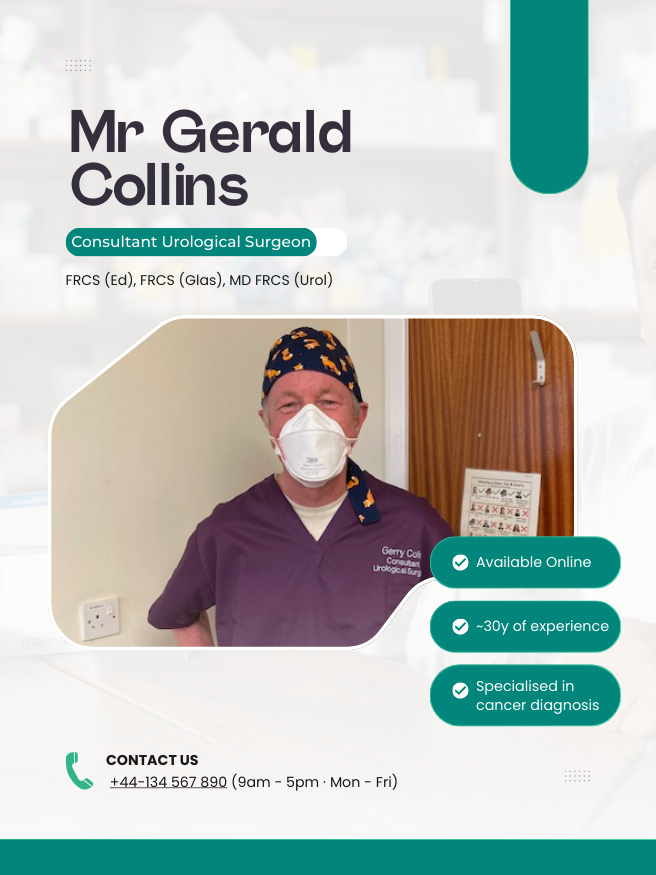
Mr. Collins Approach
Mr Gerald Collins brings nearly three decades of clinical experience to the management of kidney cancer.
His philosophy is rooted in the “Science and Art” of healing, a perspective shaped by his fifth-generation medical pedigree and his time conducting research at Edinburgh University and the Mayo Clinic in the USA.
Causes & Risk Factors
While the exact cause of most kidney cancers remains unclear, certain factors can increase your risk:
The Solution: Treatment pathways
The treatment for kidney cancer is highly personalised, depending on the stage and grade of the tumour. Mr Collins specialises in navigating these complex decisions:
Surgical Pathways:
- Partial Nephrectomy: Whenever possible, we aim to remove only the tumour, preserving as much healthy kidney tissue as possible. This is often the preferred route for smaller masses.
- Radical Nephrectomy: In cases where the tumour is large or centrally located, the entire kidney may need to be removed. The body can function perfectly well with one healthy kidney.
Medical and Minimally Invasive Pathways:
- Active Surveillance: For very small, slow-growing tumours in older patients or those with other health concerns, monitoring the mass with regular scans may be the safest “measured intervention.”
- Ablation Therapies: For patients unsuitable for surgery, techniques like Cryotherapy (freezing) or Radiofrequency Ablation (using heat) can destroy cancer cells.
- Advanced Therapies: For cancer that has spread beyond the kidney (metastatic), modern treatments include immunotherapy and targeted drug therapies, which have revolutionised outcomes in recent years.
How to Prevent?
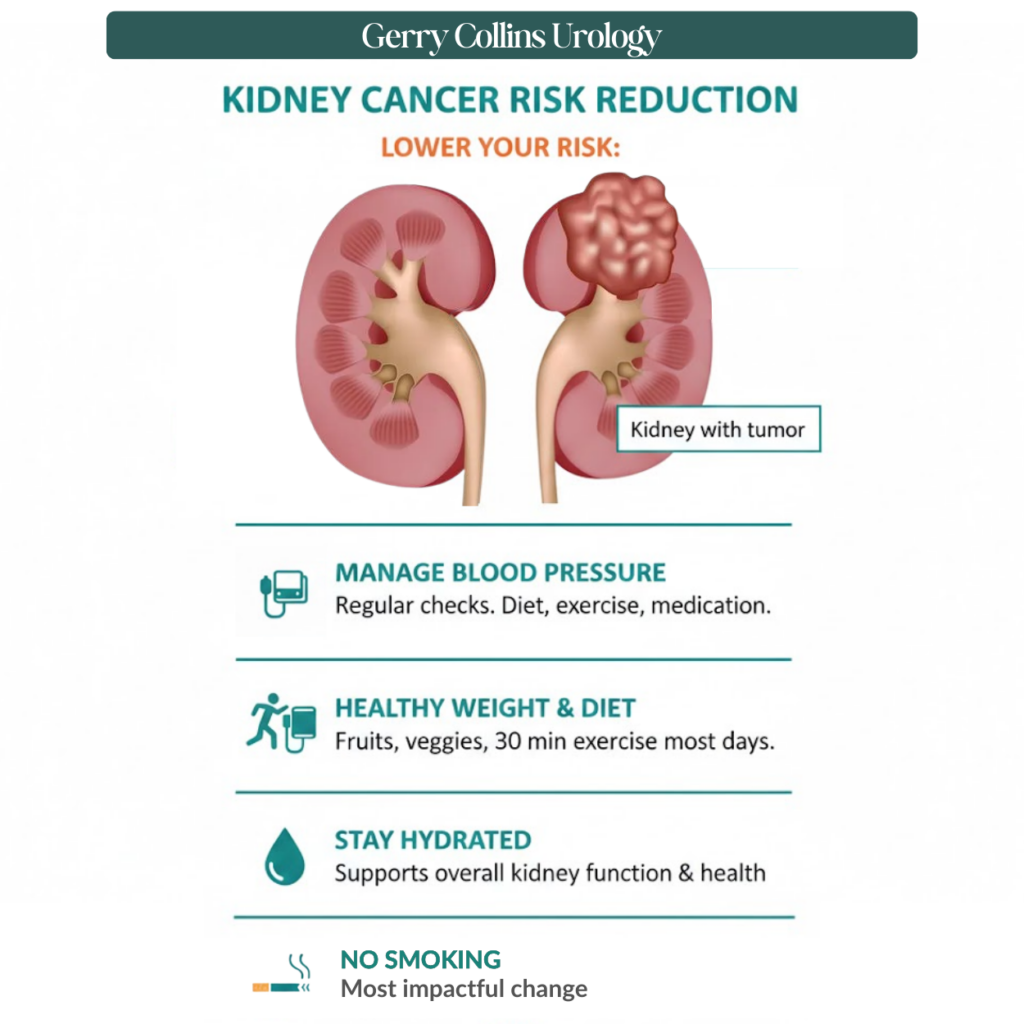
While you cannot change your genetics, you can take active steps to lower your risk:
- Stop Smoking: This is the single most impactful change you can make for urological health.
- Manage Your Blood Pressure: Have your blood pressure checked regularly by your GP. If it is high, manage it through a combination of diet, exercise, and medication.
- Maintain a Healthy Weight: A diet rich in fruits and vegetables, combined with at least 30 minutes of exercise most days, helps regulate the hormonal and inflammatory markers linked to kidney cancer.
- Stay Hydrated: While hydration does not directly prevent cancer, it supports overall kidney function and health.
FAQs
Can I live a normal life with only one kidney?
Yes. Most people lead perfectly healthy, full lives with one kidney. The remaining kidney usually increases in size slightly to take over the work of both.
Is a kidney cyst always cancer?
No. Kidney cysts are very common, especially as we age. We use the Bosniak classification system to grade these cysts. Simple cysts (Category I) are almost never cancerous, while complex cysts (Category IV) require surgical attention.
Is blood in the pee always a sign of cancer?
Not necessarily. It can be caused by a urinary tract infection (UTI), kidney stones, or an enlarged prostate. However, visible blood in the urine must always be investigated by a urologist to rule out serious underlying causes.
Why was my kidney cancer found “by accident”?
Many kidney tumours are “incidentalomas,” meaning they are found during an ultrasound or CT scan for something else, such as gallstones or back pain. This is actually a positive outcome, as it usually means the cancer is caught at an early, highly treatable stage.
Based in Manchester and Cheshire, Mr Gerald Collins is currently accepting private consultations for the assessment of kidney masses, haematuria, and general urological concerns. With 29 years of experience, he provides the clarity and expertise needed to move from uncertainty to a confident treatment plan.