+44 0161 495 7011 (9am - 5pm ᐧ Mon - Fri)

Lower urinary tract symptoms (LUTS) is the umbrella term urologists use to describe problems affecting the bladder, the bladder neck, the prostate and the urethra. LUTS in men is one of the most common reasons for a urology referral in the UK, yet it remains one of the most frequently dismissed — often written off as an unavoidable part of ageing.
That assumption is worth challenging. Male lower urinary tract symptoms are rarely random. They usually reflect a specific, identifiable mechanical or functional change: an enlarging prostate squeezing the urethra, a bladder muscle that has become overactive, an inflammatory process, or occasionally something that needs excluding urgently. Understanding which pattern you have is what separates a guessed prescription from a treatment plan that actually works.
What Does LUTS Stand For? (LUTS Meaning & Definition)
LUTS is the medical abbreviation for Lower Urinary Tract Symptoms. The “lower urinary tract” refers to the bladder and urethra — as opposed to the upper urinary tract, which is the kidneys and ureters.
Crucially, LUTS is a description, not a diagnosis. It tells you what you are experiencing, not why. Two men with identical symptom scores can have entirely different underlying causes and therefore entirely different treatment pathways. The clinical work is in the “why”.
Did you know:
Lower urinary tract symptoms are remarkably common as men age. In the UK and Europe, approximately 14 percent of men in their 40s experience these symptoms, a figure that rises sharply to 40 percent in men over the age of 60.
The Three Categories: Storage, Voiding and Post-Micturition Symptoms
Urologists classify LUTS into three groups. Working out which group dominates is the single most useful step in the assessment, because storage and voiding problems are treated very differently.
Storage (Irritative) Lower Urinary Tract Symptoms
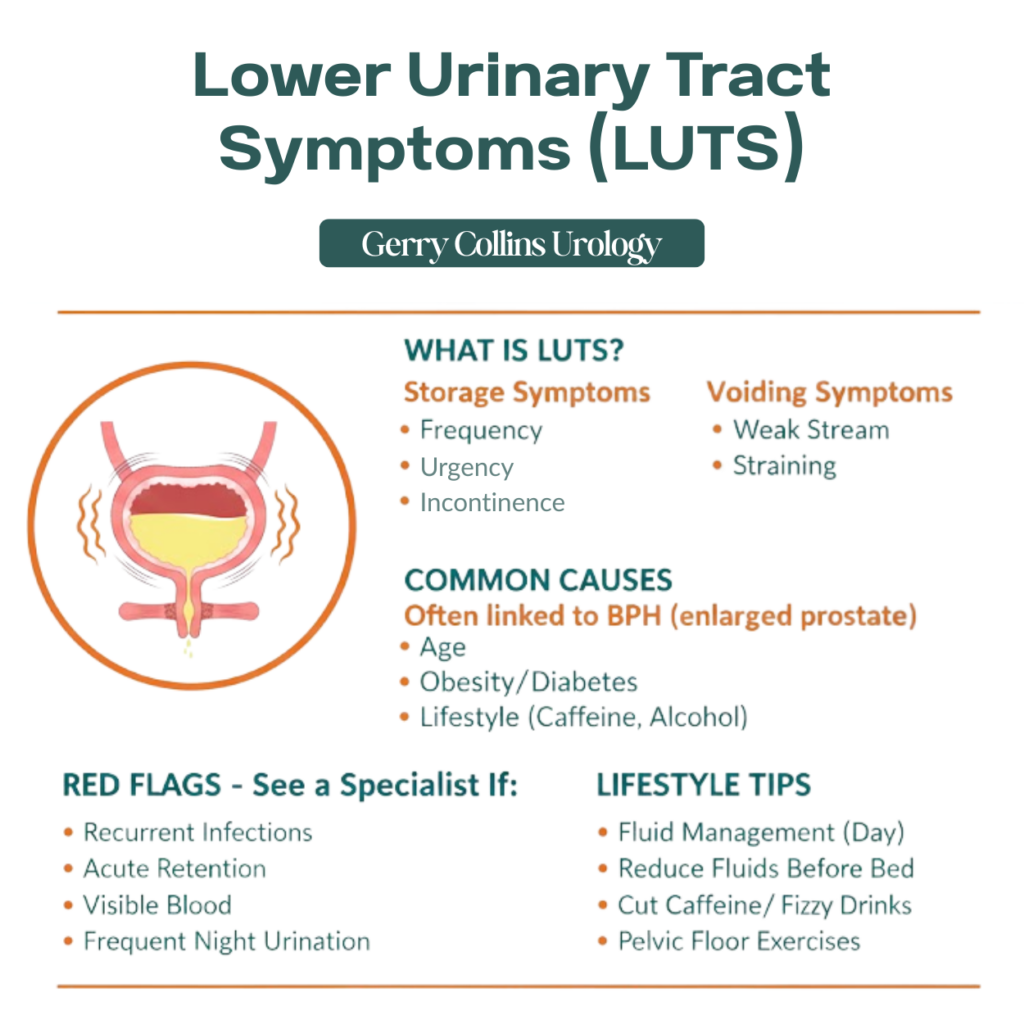
Storage lower urinary tract symptoms occur while the bladder is filling — the bladder is failing to hold urine comfortably. These are also described as irritative LUTS, because the bladder behaves as though it is being irritated. They include:
- Urinary frequency — passing urine more than approximately eight times in 24 hours
- Urgency — a sudden, compelling need to pass urine that is difficult to defer
- Nocturia — waking once or more each night to urinate
- Urgency incontinence — leakage that occurs before you reach the toilet, covered in detail in our guide to urinary incontinence in men
Persistent storage symptoms with pelvic or bladder pain, particularly where infection has been repeatedly excluded, may point towards interstitial cystitis or bladder pain syndrome rather than a prostate problem.
Voiding (Obstructive) Lower Urinary Tract Symptoms
Obstructive lower urinary tract symptoms occur during urination itself, when urine cannot leave the bladder freely. They are the classic signature of bladder outlet obstruction:
- Hesitancy — a delay before flow starts
- Weak or slow stream — reduced force, taking longer to empty
- Intermittency — flow that stops and starts
- Straining — needing abdominal effort to maintain flow
- Incomplete emptying — the bladder never feels properly empty
Obstructive symptoms are most commonly caused by benign prostatic hyperplasia (BPH), but can also result from a urethral stricture or bladder neck stenosis.
Post-Micturition Symptoms
The most common is post-micturition dribble — a small leak in the minutes after leaving the toilet, caused by urine pooling in the bulbar urethra. It is benign but socially frustrating, and usually responds well to urethral milking and pelvic floor training.
An important point: most men have mixed LUTS — a combination of storage and voiding symptoms. Treating only the obvious half is the most common reason men report that treatment “didn’t really work”.
Red Flag Symptoms — When to Seek Specialist Review
While LUTS often develops gradually, certain “red flags” indicate that the bladder or kidneys may be under significant stress. You should seek a specialist consultation if you experience:
- Recurrent Infections: Frequent urinary tract infections (UTIs) which may suggest the bladder is not emptying completely.
- Acute Urinary Retention: A sudden, painful inability to pass any urine at all (this is a medical emergency).
- Visible Haematuria: Any episode of visible haematuria requires structured investigation. It is the cardinal symptom of bladder cancer and can also be the first sign of kidney cancer. Our full guide to haematuria — blood in the urine explains the pathway.
- Urgency Incontinence: A sudden, uncontrollable need to urinate that results in leakage before reaching a toilet.
- Nocturia: waking three or more times nightly, which disrupts sleep architecture, worsens metabolic control and increases falls risk in older men. Because night-time falls are a leading cause of fracture, we also recommend reading our guide to bone health in men.

Mr Gerry’s Approach
In many modern clinics, LUTS is met with a reflex prescription or a standard surgical recommendation. Mr. Collins instead utilises advanced diagnostics like Urodynamics, PSA density and Stockholm3 to filter the clinical “noise.”
He believes every treatment plan must be tailored to the individual’s baseline and long-term goals. By analysing the trends in data rather than reacting to a single flow test, he ensures that interventions are measured, strategic, and never rushed.
Causes and Risk Factors for LUTS in Men
The most frequent cause of LUTS in men is the enlargement of the prostate gland (BPH). As men age, hormonal shifts involve the conversion of testosterone into dihydrotestosterone (DHT), which triggers prostate growth. This growth can squeeze the urethra, forcing the bladder to work harder to expel urine.
How LUTS Is Assessed
A structured assessment typically includes:
- IPSS (International Prostate Symptom Score) — a validated 8-question tool scoring severity as mild (0–7), moderate (8–19) or severe (20–35), and quantifying bother.
- Bladder diary — three days of fluid intake and voided volumes, which frequently reveals excessive fluid intake or nocturnal polyuria as the true driver.
- Digital rectal examination — assessing prostate size, consistency and any irregularity.
- Urine dipstick and culture — excluding infection, glycosuria and haematuria.
- Uroflowmetry and post-void residual — objective measurement of flow rate and how much urine remains.
- PSA testing, interpreted properly. PSA rises with prostate volume, age, infection and inflammation — not only with cancer. Our guides to PSA levels by age and when a raised PSA is not cancer explain how to read the result in context.
- Urodynamics — reserved for complex or unclear cases, distinguishing genuine obstruction from a poorly contracting bladder before any surgery is considered.
- Imaging and biopsy where indicated — including multiparametric prostate MRI and, if required, MRI-guided prostate biopsy.
Treatment pathways
Treatment is dictated by the severity of the symptoms and the degree of obstruction. Mr. Collins advocates for a risk-stratified approach.
Medical Management:
- Alpha-blockers: These medications (such as Tamsulosin) relax the muscle fibres in the prostate and bladder neck, making it easier to urinate.
- 5-alpha reductase inhibitors: Drugs like Finasteride work by blocking the hormones that cause the prostate to grow, effectively shrinking the gland over six months.
- Combination Therapy: Often the most effective route for mild to moderate symptoms.
- Antimuscarinics and beta-3 agonists (e.g. solifenacin, mirabegron) target storage/irritative symptoms driven by an overactive bladder.
Surgical Pathways:
- TURP (Transurethral Resection of the Prostate): The traditional “gold standard” where obstructing tissue is removed to clear the channel.
- Holep and other types of laser.
- Bladder Neck Incision: A strategic option for men with smaller but highly obstructive prostates.
- Minimally invasive options (UroLift, Rezum): considered where preserving ejaculatory function is a priority.
Lifestyle tips to do at home
While you cannot halt the biological clock, you can manage the “noise” of LUTS through proactive habits:
- Fluid Management: Reduce fluid intake two to three hours before bed to manage nocturia, but ensure you drink 1.5 to 2 litres during the day to keep urine diluted.
- Bladder Retraining: If you suffer from frequency, try to gradually increase the time between bathroom visits to “re-educate” the bladder muscle.
- The “Double Void” Technique: After passing urine, wait a few moments and try again to ensure the bladder is fully empty.
- Dietary Adjustments: Reduce caffeine and fizzy drinks, both of which act as significant bladder irritants.
- Pelvic Floor Exercises: Often associated only with women, pelvic floor strength is vital for men to manage “post-micturition dribble” and urgency.
FAQs
Does having LUTS mean I have prostate cancer?
No. Most LUTS are caused by benign enlargement (BPH). However, because the symptoms can overlap, Mr Collins performs a thorough assessment, including PSA interpretation and physical examination, to exclude malignancy.
Will LUTS surgery affect my sexual function?
Procedures like TURP carry a high likelihood of “retrograde ejaculation” (where semen enters the bladder during climax). While this does not affect the sensation of orgasm, it is a key consideration for men concerned about fertility. True erectile dysfunction is a less common risk (approx 7-10%) and should be discussed during your consultation.
Can I just “wait and see”?
If symptoms are mild and not distressing, “Watchful Waiting” is a valid pathway. However, if the bladder is constantly struggling against an obstruction, it can lead to permanent thickening of the bladder wall or kidney damage. Early data-led intervention is always safer than waiting for a crisis.
Why am I waking up at night even if I don’t drink much?
This can be due to reduced bladder capacity or “peripheral oedema.” Suppose your ankles swell during the day, that fluid returns to the bloodstream when you lie down, prompting the kidneys to produce more urine at night. Mr Collins looks at these systemic factors to find the root cause.
What does LUTS stand for in medical terms?
LUTS is the medical abbreviation for Lower Urinary Tract Symptoms. It covers all symptoms arising from the bladder, bladder neck, prostate and urethra, grouped into storage, voiding and post-micturition symptoms. You may also see the related abbreviation LUT used simply for “lower urinary tract”.
Is LUTS the same as a lower urinary tract infection?
No. A lower UTI (cystitis) is a bacterial infection producing burning, urgency and cloudy urine, usually developing over hours to days and treated with antibiotics. LUTS is a broader symptom description that usually develops over months or years and is most often non-infective. Recurrent lower UTIs in men, however, are themselves a red flag for incomplete bladder emptying.