+44 0161 495 7011 (9am - 5pm ᐧ Mon - Fri)

Prostate-specific antigen (PSA) is a protein made almost exclusively by the prostate gland. A PSA test simply measures how much of it is circulating in your blood. Its primary biological role is to liquefy semen, optimising sperm motility and morphology. Small amounts of PSA in the blood are entirely normal. An elevation can be a signal of several different conditions, ranging from benign enlargement and inflammation through to prostate cancer. Prostate cancer tissue produces approximately 10 times more PSA than benign tissue.
The real challenge in modern urology is the mildly raised PSA level between 4 and 10 ng/mL, often called the “grey zone.” In this range, the majority of men do not have clinically significant cancer, which creates a genuine diagnostic dilemma in deciding who needs further investigation or biopsy. To move beyond a “one size fits all” interpretation, we look at PSA derivatives age-specific reference ranges, Free PSA, and PSA Density — to understand the unique biology of the individual, rather than judging everyone against a single cut-off number.
Relevant Fact:
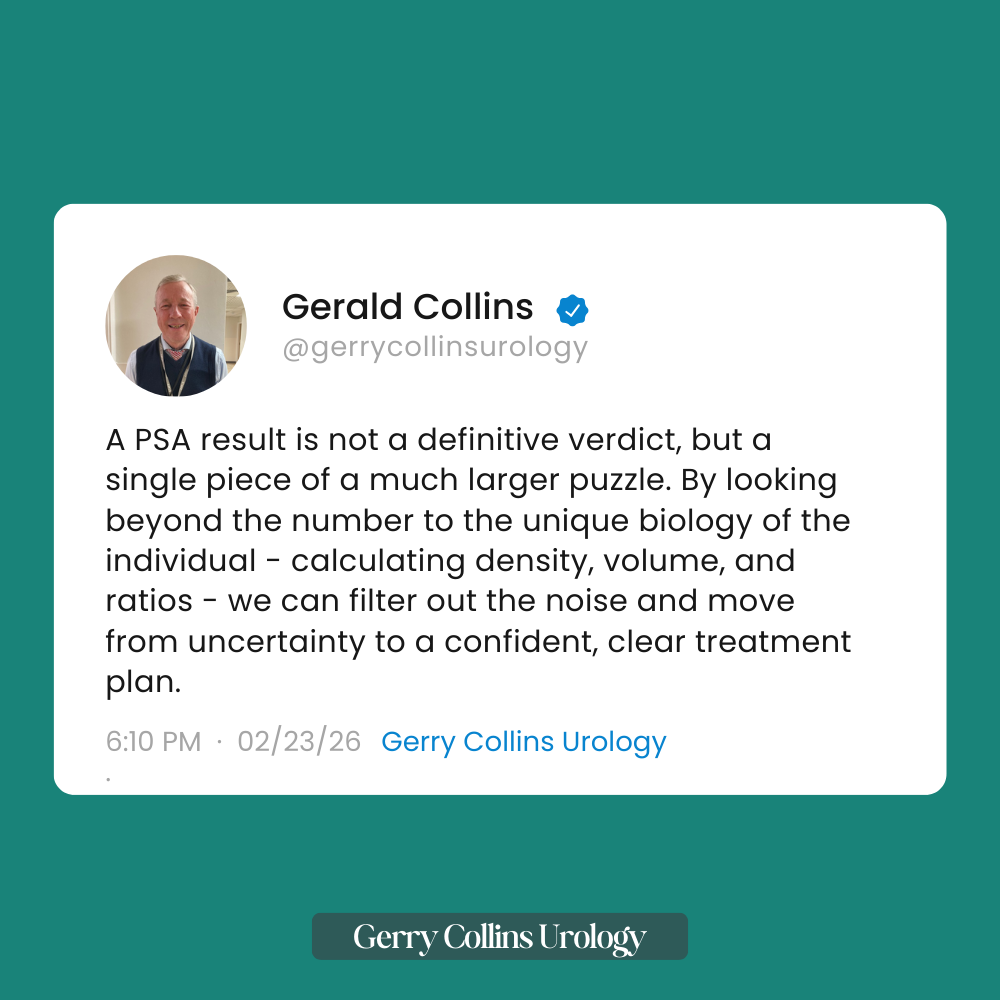
Research published in 2025 indicates that the PSA Density (PSAD) and the PSA-Age Volume index (PSA-AV) significantly outperform standard PSA tests in terms of diagnostic accuracy. In patients with PSA levels below 10 ng/mL, PSAD has shown a specificity as high as 94.7 percent, helping to rule out cancer more effectively than traditional methods.
What Is Free PSA?
PSA circulates in the blood in two forms: bound to blood proteins, or “free” (unbound). The free-to-total PSA ratio (often written as %free PSA) compares the two.
Men with prostate cancer tend to have proportionally less free PSA and more protein-bound PSA, while men with benign prostatic enlargement tend to have proportionally more free PSA. As a general guide used in UK and international practice:
- Above ~25% free PSA — generally reassuring, more consistent with benign enlargement than cancer
- Roughly 10–25% — an intermediate range that needs to be considered alongside age, prostate volume and trend over time
- Below ~10–15% — associated with a higher likelihood of clinically significant disease
The free PSA test adds the most value when your total PSA sits in that 4–10 ng/mL grey zone, where it can help avoid an unnecessary biopsy in men whose ratio is reassuring.
What Is PSA Density (PSAD)?
PSA Density adjusts your PSA result for the size of your prostate, calculated as:
PSA Density = Total PSA (ng/mL) ÷ Prostate Volume (cc)
Prostate volume is measured directly via ultrasound or MRI, typically as part of prostate imaging and biopsy assessment.
Worked example: a PSA of 6 ng/mL in a 30cc prostate gives a PSAD of 0.20 ng/mL/cc. The same PSA of 6 ng/mL in an 80cc prostate gives a PSAD of just 0.075 ng/mL/cc — a very different clinical picture from the same headline PSA number, simply because the second man’s naturally larger gland accounts for most of the reading.
As a general guide:
- Below ~0.10 ng/mL/cc — low probability of harbouring clinically significant cancer
- Around 0.10–0.15 ng/mL/cc — intermediate, weighed alongside other factors such as MRI findings
- Above ~0.15 ng/mL/cc — the most widely cited benchmark prompting closer review, though it is a guide rather than an absolute rule
These figures are not diagnostic on their own — they’re one input, alongside age, MRI findings and clinical history, that Mr Collins uses to build a full risk picture. They should always be interpreted by a specialist rather than compared against in isolation.
Symptoms
A raised PSA result is most often picked up during routine screening or blood tests, long before any physical symptoms appear; this is precisely why the test exists. You should consult a specialist even if you have no symptoms at all. That said, PSA testing is also often considered alongside new lower urinary tract symptoms such as nocturia, urinary frequency, hesitancy or urgency, so it’s worth mentioning any of these to your doctor when a test is arranged.
Causes of a Raised PSA — Not Always Cancer
An elevated PSA is a signal to investigate, not a diagnosis. The most common non-cancerous causes include a naturally enlarged prostate (BPH), infection or inflammation of the gland (prostatitis), recent ejaculation or vigorous cycling, and recent urological procedures. For a full breakdown of these causes, see our guide to when a high PSA is not cancer.
Mr Collins Approach
Mr Gerry Collins views a PSA result not as a definitive verdict; he incorporates your prostate volume, your age, and the “Free to Total” PSA ratio to build a risk-stratified map. By using advanced tools like the Stockholm3 biomarker test and MRI-guided interpretations, he filters out the benign causes of PSA elevation, such as inflammation or BPH, ensuring that only those who truly need an intervention proceed to biopsy.
FAQs
What is the “Free to Total” PSA ratio?
PSA circulates in the blood in two forms: bound to proteins or “free.” Men with prostate cancer tend to have more bound PSA and less free PSA. A ratio (Free/Total) of less than 10 to 20 percent may indicate a higher risk of malignancy.
Does a large prostate mean I have cancer?
Not necessarily. A large prostate (BPH) will produce more PSA. This is why we calculate PSA Density: dividing the PSA level by the volume of the prostate (measured by scan). If the density is low, the rise is likely due to size, not cancer.
What are the age-specific thresholds?
NHS guidelines generally suggest:
– 40 to 49 years: >2.5 ng/ml
– 50 to 69 years: >3.0 ng/ml
– Over 70 years: >5.0 ng/ml
However, these are starting points; the trend over time is often more important than a single reading.
Can medications affect my PSA?
Yes. Medications for an enlarged prostate, such as Finasteride or Dutasteride, can artificially lower your PSA by about 50 percent. It is vital to tell your consultant if you are taking these, as we must “double” the result to see the true clinical picture.
What does a PSA test result actually mean?
A PSA test result on its own doesn’t diagnose or rule out anything; it’s a starting point. A raised result simply means further assessment is needed, which may include repeat testing, an MRI scan, or calculating your free PSA and PSA density, before any decision is made about a biopsy.
Based in Manchester and Cheshire, Mr Gerald Collins is a Consultant Urological Surgeon currently accepting private consultations for PSA interpretation, prostate assessment, and general urological concerns at Spire Manchester Hospital, Circle Alexandra Hospital in Cheadle, and Spire Regency Hospital in Macclesfield. With 29 years of experience, he provides the clarity and expertise needed to move from uncertainty to a confident treatment plan.