+44 0161 495 7011 (9am - 5pm ᐧ Mon - Fri)

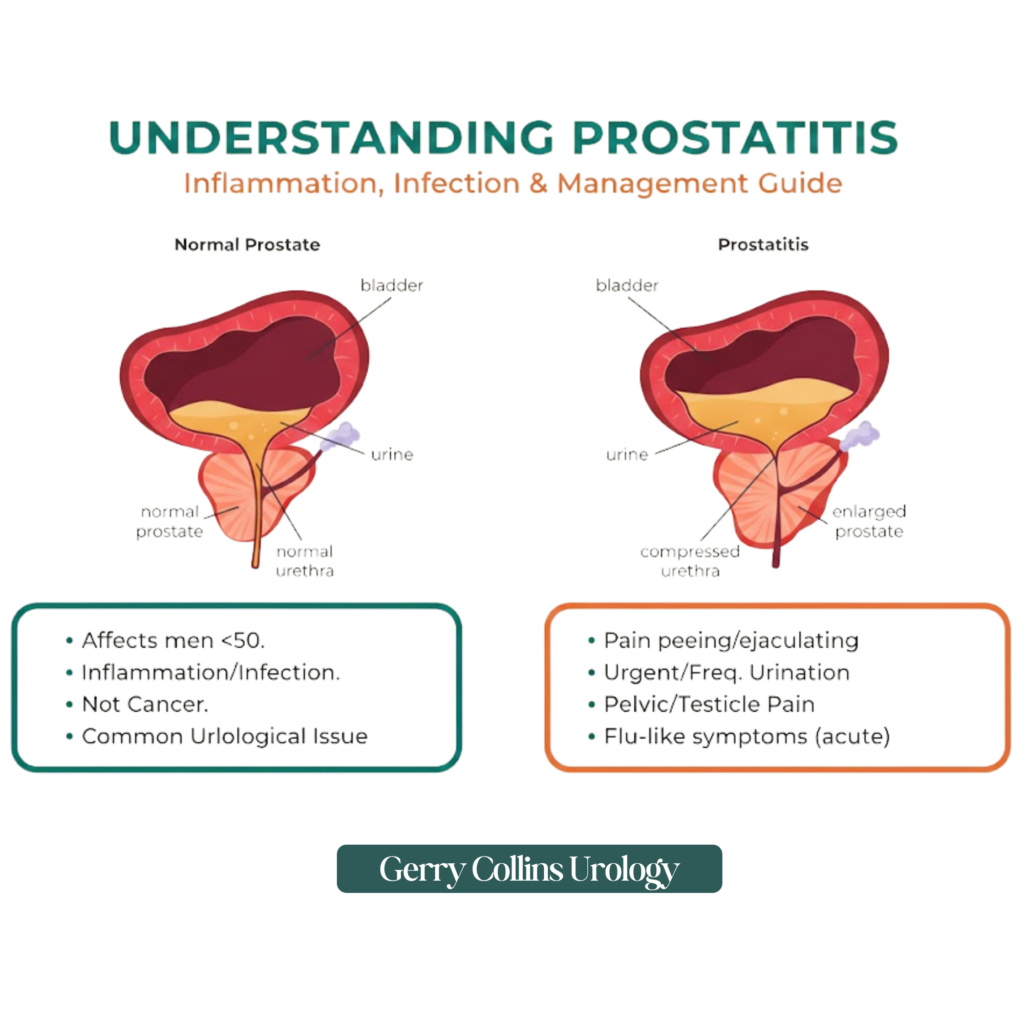
Prostatitis (pronounced pross-tuh-TY-tiss) is inflammation or infection of the prostate gland. It is the most common urological diagnosis in men under 50, and roughly one in ten men will experience it at some stage of life. The prostate sits directly beneath the bladder and surrounds the urethra, so when the gland becomes inflamed, the result is usually a combination of pelvic pain and disruption to urination.
Prostatitis is not cancer, and having it does not raise your long-term risk of developing prostate cancer. It is also distinct from benign prostatic hyperplasia (BPH), the age-related enlargement of the gland that tends to affect men over 50. The confusion is understandable, as all three conditions can produce overlapping lower urinary tract symptoms (LUTS), but the causes, investigations and treatments are entirely different.
While the symptoms can be distressing, it is important to remember that prostatitis is not cancer.
Did you know
Some studies suggest that as many as 10 percent of adult males suffer from prostatitis at some point in their lives. Despite its prevalence, it remains one of the most challenging conditions to diagnose because its symptoms frequently overlap with other urological health issues.
Prostatitis: Key Facts
- What it is: Inflammation or infection of the prostate gland
- Who it affects: The most common urological diagnosis in men under 50; around one in ten men in their lifetime
- Most common type: Chronic pelvic pain syndrome (CPPS), roughly 90 per cent of cases
- Key symptoms: Pelvic or perineal pain, painful urination, painful ejaculation, urinary frequency
- Is it cancer: No — prostatitis is benign and does not cause prostate cancer
- Treatment: Depends entirely on type — antibiotics for bacterial cases, multimodal management for CPPS
Despite how common it is, prostatitis remains one of the most challenging urological conditions to diagnose, because its symptoms overlap so heavily with other problems and because the most common form leaves no trace on a standard urine test.
The Four Types of Prostatitis
Urologists classify prostatitis into four categories. Establishing which type you have is the single most important step in treatment, because managing a non-bacterial condition with repeated antibiotic courses is both ineffective and counterproductive.
Acute Bacterial Prostatitis (Type I)
A sudden, severe bacterial infection of the prostate. Men typically present with fever, rigours, lower back pain, difficulty passing urine and marked perineal discomfort. This is the least common form but the most serious, and it requires prompt antibiotic treatment. Left untreated, it can progress to a prostatic abscess or to sepsis.
Chronic Bacterial Prostatitis (Type II)
A persistent or recurring bacterial infection, often characterised by repeated urinary tract infections caused by the same organism. Symptoms are milder than in the acute form but tend to relapse once a course of antibiotics finishes, because bacteria persist within the prostatic ducts where antibiotic penetration is poor. This is why prostatitis so often masquerades as a urinary infection that simply will not clear.
Chronic Prostatitis / Chronic Pelvic Pain Syndrome (Type III)
By far the most common form, accounting for roughly 90 per cent of cases. CPPS involves persistent pelvic pain lasting three months or longer with no bacteria identifiable on culture. It is best understood not as a simple infection but as a disorder of pelvic floor muscle tension, nerve sensitisation and inflammation acting together, which is precisely why a single-agent approach so often fails.
CPPS shares considerable overlap with interstitial cystitis and bladder pain syndrome, and the two conditions are sometimes managed along similar lines.
Asymptomatic Inflammatory Prostatitis (Type IV)
Inflammation of the prostate discovered incidentally, usually during investigation of infertility, or on a biopsy specimen taken for another reason in a man with no symptoms at all. It generally requires no treatment, but it is a common explanation for an unexpectedly raised PSA in the absence of cancer.
Prostatitis Symptoms: What to Look Out For
Because the symptoms of prostatitis can be vague or mimic other conditions, it is crucial to seek a specialist opinion if you experience any of the following:
- Pain or a burning sensation when peeing (dysuria).
- Frequent or urgent need to urinate, especially during the night.
- Pain in the perineum (the area between the scrotum and the anus), testicles, or tip of the penis.
- Discomfort or pain during or after ejaculation.
- A feeling that the bladder has not fully emptied.
- Flu-like symptoms such as fever, chills, and lower back pain (typically seen in acute cases).
- A sudden, overwhelming need to pass urine that is difficult to defer, which can overlap with urinary urgency and incontinence
- Traces of blood in the urine or semen. This is not typical of prostatitis and always requires investigation see our guide to haematuria
Urgent Notice:
If you suddenly find you are unable to pee at all, or if you have a high temperature accompanied by severe shivering (rigours), you should seek immediate medical help at an A&E department, as this can indicate a serious infection or sepsis.

Mr. Collins Approach
With nearly three decades of experience, Mr. Collins understands that prostatitis can cause significant “noise” in diagnostic data, such as elevated PSA levels.
His approach filters this noise by integrating advanced risk-stratification tools and a deep understanding of prostate biology. He ensures that every patient receives a strategic, measured intervention rather than a rushed or generic treatment plan.
Where Is Prostate Pain Felt?
Prostate pain is rarely felt over the gland itself. Because the prostate shares its nerve supply with surrounding pelvic structures, discomfort is usually referred elsewhere, most often to the perineum, the area between the scrotum and the anus, but commonly also to the tip of the penis, the testicles, the lower abdomen, the groin, the lower back or the inner thighs. Men frequently describe it as a deep ache, a dragging heaviness, or the sensation of sitting on a golf ball.
Testicular ache is a particularly common feature of prostatitis and is usually referred pain rather than a problem with the testicle itself. That said, any new lump, swelling or persistent one-sided testicular pain warrants prompt examination to exclude testicular cancer.
What Causes Prostatitis?
The causes of prostatitis are varied and sometimes overlap, making a precise diagnosis essential:
Prostatitis Treatment Options
Treatment for prostatitis is never “one size fits all.” It is dictated by whether the cause is bacterial or inflammatory.
Medical Pathways:
- Targeted Antibiotics: For bacterial cases, a course of antibiotics is prescribed. While acute cases may resolve in 14 days, chronic bacterial prostatitis may require treatment for four to six weeks to ensure the infection is fully eradicated.
- Alpha-blockers: These medications help relax the muscles where the prostate meets the bladder, improving urine flow and reducing discomfort.
- Pain Management: Specialist analgesics or anti-inflammatories are used to manage pelvic discomfort and swelling.
- The UPOINT Approach: Mr Collins utilises this structured framework to address the urinary, psychosocial, organ-specific, and neurological aspects of the condition simultaneously.
- Acupuncture including moxatherapy
How Prostatitis Is Diagnosed
There is no single test for prostatitis. Diagnosis rests on building a picture from several sources, and on systematically excluding the conditions that mimic it. A typical assessment includes:
- Flexible Cystoscopy: If symptoms persist, a small telescope may be used to examine the bladder and prostate to rule out other abnormalities.
- Specialised Physiotherapy: For men with chronic pelvic pain syndrome, working with a specialist pelvic floor physiotherapist can help relax overactive muscles.
- Symptom history and scoring: Structured questionnaires quantify pain, urinary symptoms and quality-of-life impact, giving an objective baseline against which treatment response can be measured.
- Urine testing and culture: A mid-stream sample identifies bacteria in Type I and Type II prostatitis. Importantly, a clear urine culture does not rule prostatitis out — in CPPS, which accounts for most cases, cultures are negative by definition.
- Digital rectal examination: Assesses the size, consistency and tenderness of the gland. In acute infection, the prostate is usually exquisitely tender.
- PSA testing, interpreted with care: Inflammation routinely elevates PSA, and a single raised reading taken during a flare is frequently misleading. Our guides to free PSA and PSA density and PSA levels by age explain how these results should be read in context.
- Flow rate and bladder scanning: Measures the strength of the urinary stream and how completely the bladder empties, useful in distinguishing prostatitis from BPH as a cause of obstructive symptoms.
- Flexible cystoscopy: Where symptoms persist or blood is present, direct inspection of the bladder and urethra excludes bladder cancer and other structural causes.
- Imaging: Ultrasound or MRI may be used to exclude a prostatic abscess, while multiparametric MRI of the prostate can clarify a persistently raised PSA before any decision about biopsy is taken.
Lifestyle tips
While you cannot always prevent prostatitis, you can manage the symptoms and reduce the risk of flare-ups through proactive choices:
- Stay Hydrated: Drink plenty of fluids to avoid dehydration and help flush the urinary system.
- Dietary Awareness: Some men find that caffeine, alcohol, and spicy foods irritate the bladder and prostate.
- Warm Baths: “Sitz baths” (soaking the pelvic area in warm water) can help relax pelvic muscles and relieve pain.
- Stress Management: Techniques such as relaxation exercises or mindfulness can be effective, particularly for those whose symptoms are triggered by stress.
- Frequent Ejaculation: Some evidence suggests that regular ejaculation can help clear prostatic secretions and reduce congestion in the gland.
FAQs
Is a raised PSA result always cancer?
No. Prostatitis is a common cause of a high PSA result. Mr Collins uses his 30 years of experience and research into PSA derivatives to interpret these results in context, often avoiding the need for unnecessary biopsies.
Can I pass prostatitis to my partner?
In the vast majority of cases, prostatitis is not a sexually transmitted infection and cannot be passed to a partner. However, if an STI is the underlying cause of the inflammation, both partners may need treatment.
Will treatment affect my sex life?
While the condition itself can cause painful ejaculation, the treatments for prostatitis are generally focused on restoring normal function. Mr Collins prioritises the preservation of quality of life in every treatment plan.
What is the difference between Prostatitis and BPH?
BPH (Benign Prostatic Hyperplasia) is a non-cancerous enlargement of the prostate that usually affects older men and causes a weak urine stream. Prostatitis is inflammation or infection that often involves pain and can affect men of all ages, particularly those under 50.
Does prostatitis go away on its own?
Sometimes, but it should not be left to chance. Mild inflammatory episodes can settle spontaneously over a few weeks. Bacterial prostatitis will not resolve without antibiotics and can worsen quickly, while chronic pelvic pain syndrome typically persists and may become harder to treat the longer it goes unaddressed, as pain pathways become established.
What is the difference between prostatitis and a UTI?
A urinary tract infection is an infection of the bladder or urinary tract; prostatitis is inflammation or infection of the prostate itself. They produce similar urinary symptoms, but prostatitis characteristically adds pelvic, perineal or testicular pain and pain on ejaculation.
Does ejaculation help prostatitis?
For many men, yes. Regular ejaculation helps clear prostatic secretions and relieve congestion within the gland, and men with chronic prostatitis often report that longer gaps worsen their symptoms