+44 0161 495 7011 (9am - 5pm ᐧ Mon - Fri)

Benign prostatic hyperplasia — BPH for short — is the medical term for a non-cancerous enlargement of the prostate gland. If you have been told you have an “enlarged prostate”, “prostatomegaly” or “benign prostatic hypertrophy”, these all describe the same underlying condition.
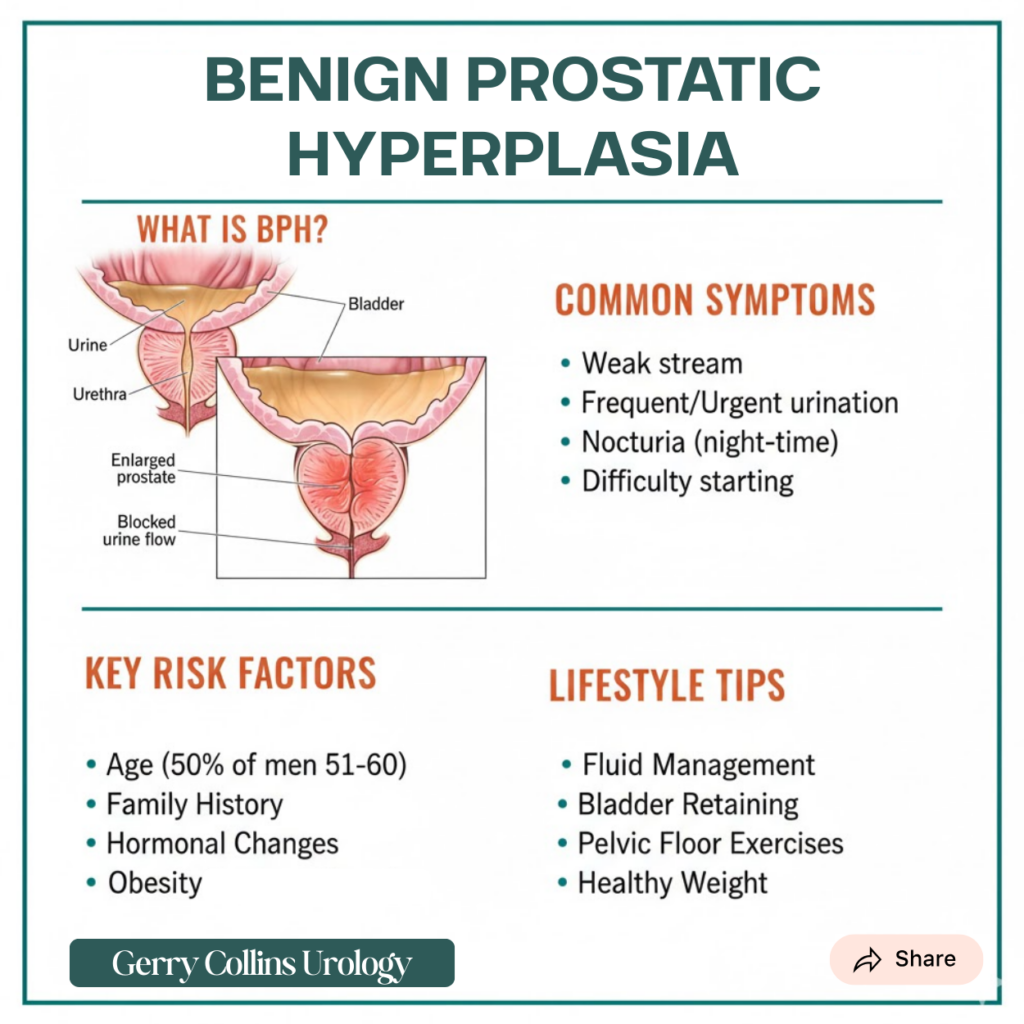
The prostate is a small gland, roughly the size of a walnut or a satsuma, sitting just below the bladder. It wraps around the urethra, the tube carrying urine out of the body. As men age, the prostate commonly grows, and because of where it sits, that growth can squeeze the urethra — rather like a kink in a garden hose making it harder to pass urine comfortably.
BPH is not cancer, and it does not increase your risk of developing prostate cancer. The two conditions can, however, coexist, which is precisely why careful assessment matters.
Did you know:
Approximately 50 percent of men between the ages of 51 and 60 will experience symptoms of BPH, and this figure rises significantly to nearly 90 percent for those over the age of 80.
Symptoms of an Enlarged Prostate
BPH develops slowly. The early signs of an enlarged prostate often feel like a minor nuisance before they begin to erode your quality of life. Collectively these are known as lower urinary tract symptoms, or LUTS.
- A weak or interrupted urinary flow.
- Difficulty starting to urinate or needing to strain.
- A frequent or urgent need to urinate, especially during the night (nocturia).
- A feeling that your bladder has not emptied completely after you have finished.
- Dribbling at the end of the stream.
While these symptoms are common, certain “red flag” situations require urgent medical attention. If you experience a complete inability to pass urine (acute urinary retention), notice blood in your urine (haematuria), or feel significant pain in the lower abdomen or bladder area, you should seek help from a GP or an emergency department immediately.

Mr Gerry’s Approach
Mr Gerry Collins views BPH not as a routine age-related issue, but as a “unique biological puzzle.” With nearly three decades of experience and having conducted significant MD research into BPH and PSA at Edinburgh University and the Mayo Clinic, he looks beyond the raw data of a flow test or a prostate volume measurement to understand how the biology of the gland is affecting the individual.
Causes & Risk Factors
The exact cause of prostate enlargement is not fully understood, but it is heavily linked to the natural ageing process.
Treatment pathways
Management of BPH follows a tiered approach, starting with the least invasive options and moving toward advanced surgical techniques if required.
Medical Pathways:
- Alpha-blockers: Medications like tamsulosin or alfuzosin work by relaxing the muscles in the prostate and bladder neck, making it easier to urinate.
- 5-alpha reductase inhibitors: Drugs such as finasteride or dutasteride can actually shrink the prostate gland by blocking the hormonal changes that cause growth.
- Combined Therapy: In many cases, using both types of medication provides the most effective relief for moderate symptoms.
Surgical & Minimally Invasive Pathways:
For those who do not find relief with medication, Mr Collins offers advanced interventions:
- Rezum (Steam Ablation): A minimally invasive procedure that uses water vapour (steam) to destroy excess prostate tissue, which is then naturally absorbed by the
- HoLEP (Holmium Laser Enucleation): A highly effective laser treatment often used for larger prostates, essentially cutting out the obstructing lump via telescope and breaking it into little pieces for extraction.
- TURP (Transurethral Resection of the Prostate): The traditional “gold standard” where excess tissue is removed by cutting away chips using an electrical current, though this is now often superseded by newer technologies using different energy forms.
The Prevention: Lifestyle tips to do at home
While you cannot stop the natural growth of the prostate, you can manage the symptoms and support bladder health through proactive habits:
- Fluid Management: Reduce fluid intake in the late evening, particularly caffeine and alcohol, to minimise trips to the bathroom at night.
- Bladder Retraining: Try to gradually increase the time between bathroom visits to strengthen the bladder’s capacity.
- Double Voiding: After you finish urinating, wait a few moments and try again to ensure the bladder is as empty as possible.
- Pelvic Floor Exercises: Strengthening the muscles around the bladder can improve control and reduce urgency or leaking.
- Maintain a Healthy Weight: A diet rich in vegetables and healthy fats can help regulate the hormones associated with prostate growth.
BPH vs prostate cancer: what’s the difference?
This is the question that brings most men to the clinic, and it deserves a direct answer.
BPH is a benign overgrowth of prostate tissue in the central zone of the gland, around the urethra, which is why it causes urinary symptoms early. Prostate cancer typically begins in the outer (peripheral) zone, away from the urethra, which is why it often causes no symptoms at all until it is advanced.
The practical implication is uncomfortable but important: urinary symptoms point towards BPH, but the absence of urinary symptoms tells you nothing reassuring about cancer. The two are assessed separately. An enlarged prostate also produces more PSA, so a raised reading in a man with BPH frequently has a benign explanation rather than a cancerous one
FAQs
Does an enlarged prostate mean I have cancer?
No. BPH is a benign (non-cancerous) condition. While the symptoms of BPH and prostate cancer can sometimes overlap, BPH does not lead to cancer. However, because both are more common as men age, Mr Collins recommends regular assessment to ensure an accurate diagnosis.
Will BPH surgery affect my sex life?
Traditional surgeries like TURP carry a risk of “retrograde ejaculation.” However, modern, minimally invasive treatments like UroLift and Rezum are specifically designed to preserve sexual and ejaculatory function though may be slightly less effective in dealing with the obstruction. This is a key part of the consultation process with Mr. Collins.
Is the PSA test useful for BPH?
Yes, but it must be interpreted with “Clinical Discernment.” An enlarged prostate produces more PSA (Prostate-Specific Antigen), which can lead to a raised result even without cancer. Mr. Collins uses PSA density (adjusting the result for the size of your prostate) to get a clearer picture of your health.
Can I just “wait and see”?
If your symptoms are mild and not bothering you, “watchful waiting” is a valid pathway. However, if you are straining to pee or feeling incomplete emptying, it is better to act early to prevent long-term damage to the bladder muscle.
What does BPH stand for?
BPH stands for benign prostatic hyperplasia. “Benign” means non-cancerous, “prostatic” refers to the prostate gland, and “hyperplasia” means an increase in the number of cells. You may also see it written as benign prostatic hypertrophy, or referred to as prostatomegaly or prostatism.
Will an enlarged prostate go away on its own?
No prostate growth tends to continue slowly with age. Symptoms can fluctuate, and mild symptoms may settle with lifestyle changes, but the underlying enlargement does not resolve without treatment.
What shrinks the prostate?
5-alpha reductase inhibitors such as finasteride and dutasteride are the only medications that genuinely reduce prostate volume, typically by around 20–30% over six months. Alpha-blockers relieve symptoms but do not change the size of the gland.
Where can I see a BPH specialist in Manchester or Cheshire?
Mr Gerry Collins consults across Manchester, Cheshire and Macclesfield, offering full assessment, medical management and the complete range of surgical options including Rezum, UroLift, HoLEP and TURP. Book a consultation.