📞 +44 0161 495 7011 (9am - 5pm ᐧ Mon - Fri)


Prostate cancer remains the most common cancer in men across the UK, with approximately 52,000 new cases diagnosed annually. For decades, the primary tool for early detection has been the Prostate-Specific Antigen (PSA) blood test. While the PSA test has saved countless lives, it is a blunt instrument. It often fails to distinguish between aggressive, life-threatening tumours and slow-growing, indolent ones that may never cause harm. This lack of specificity leads to “the noise” of overdiagnosis, resulting in unnecessary biopsies and significant patient anxiety.
The Stockholm3 (STHLM3) model represents a major shift toward precision medicine. It is an advanced, risk-based blood test designed to refine detection by combining protein biomarkers, genetic markers, and clinical data into a sophisticated algorithm. By looking beyond a single number, it provides a much clearer picture of an individual’s true biological risk.
Relevant Fact:
Clinical studies involving over 90,000 men have demonstrated that the Stockholm3 test can reduce unnecessary biopsies by up to 52 percent while detecting nearly double the number of aggressive cancers in men with low PSA values (between 1.5 and 2.9 ng/ml) who might otherwise have been missed.
Symptoms
Early-stage prostate cancer often presents no symptoms at all. However, as the prostate enlarges, whether due to benign growth (BPH) or malignancy, you may notice:
- An increased urgency to urinate, particularly at night (nocturia).
- A weak or interrupted urinary flow.
- Difficulty starting to urinate or straining to empty the bladder.
- The presence of blood in the urine or semen (haematuria).
- Persistent pain in the back, hips, or pelvis, which can sometimes indicate more advanced disease.
If you experience these symptoms, it is essential to seek a specialist evaluation rather than relying solely on a standard PSA result.ent.
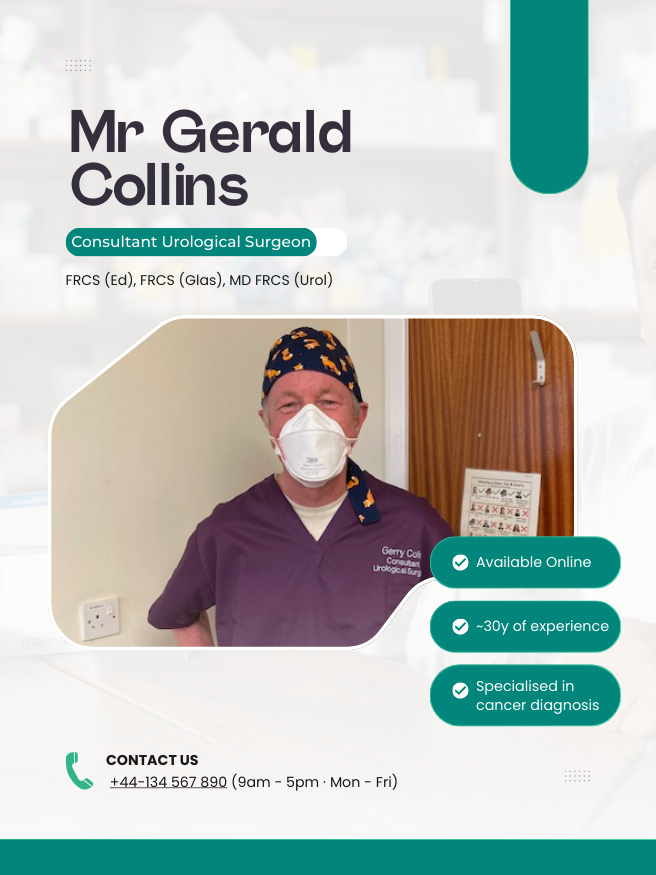
Mr. Collins Approach
While many clinics might move straight from a raised PSA to an invasive biopsy, Mr. Collins uses the Stockholm3 test as a critical “reflex test”. By integrating this advanced biomarker assessment with MRI interpretation and PSA density, he ensures that patients are never rushed into over-treatment for insignificant conditions, nor are they left in the dark about aggressive biology.
Causes & Risk Factors
While the exact cause of most kidney cancers remains unclear, certain factors can increase your risk:
FAQs
Is the Stockholm3 test a replacement for the PSA test?
Not entirely. It is best used as a “reflex test.” If your PSA is 1.5 ng/ml or higher, the Stockholm3 algorithm adds much-needed context by analysing additional protein markers and your genetic profile to decide if a biopsy is truly necessary.
Can this test help me avoid a biopsy?
Yes. Research published in European Urology Focus indicates that the Stockholm3 model can avoid 76 percent of negative biopsies. It helps ensure that only those who truly need an invasive procedure undergo one.
Does a high score mean I definitely have cancer?
A high risk score (usually 11 percent or higher) indicates a significantly increased probability of aggressive cancer. It is a signal that further investigation, such as an MRI or a targeted biopsy, is the next logical step.
What biomarkers does it actually check?
The test looks at five plasma protein markers, including total PSA, free PSA, human glandular kallikrein 2 (hK2), and microseminoprotein beta (MSMB), alongside 101 genetic markers.
Is the test available on the NHS?
While the Stockholm3 test is currently being evaluated by NICE and used in various private settings, it is not yet the standard across all NHS trusts. Mr Collins offers this advanced diagnostic tool to his private patients in Manchester and Cheshire to provide the highest level of diagnostic accuracy.
Based in Manchester and Cheshire, Mr Gerald Collins is currently accepting private consultations for the assessment of kidney masses, haematuria, and general urological concerns. With 29 years of experience, he provides the clarity and expertise needed to move from uncertainty to a confident treatment plan.