+44 0161 495 7011 (9am - 5pm ᐧ Mon - Fri)

The PSA (Prostate-Specific Antigen) test is a vital tool in modern urology, but it is often the source of significant patient anxiety. PSA is a protein produced by both normal and malignant cells in the prostate gland. While it is commonly associated with prostate cancer screening, a raised PSA level is not a definitive diagnosis of cancer. Instead, it serves as a clinical indicator that requires expert interpretation.
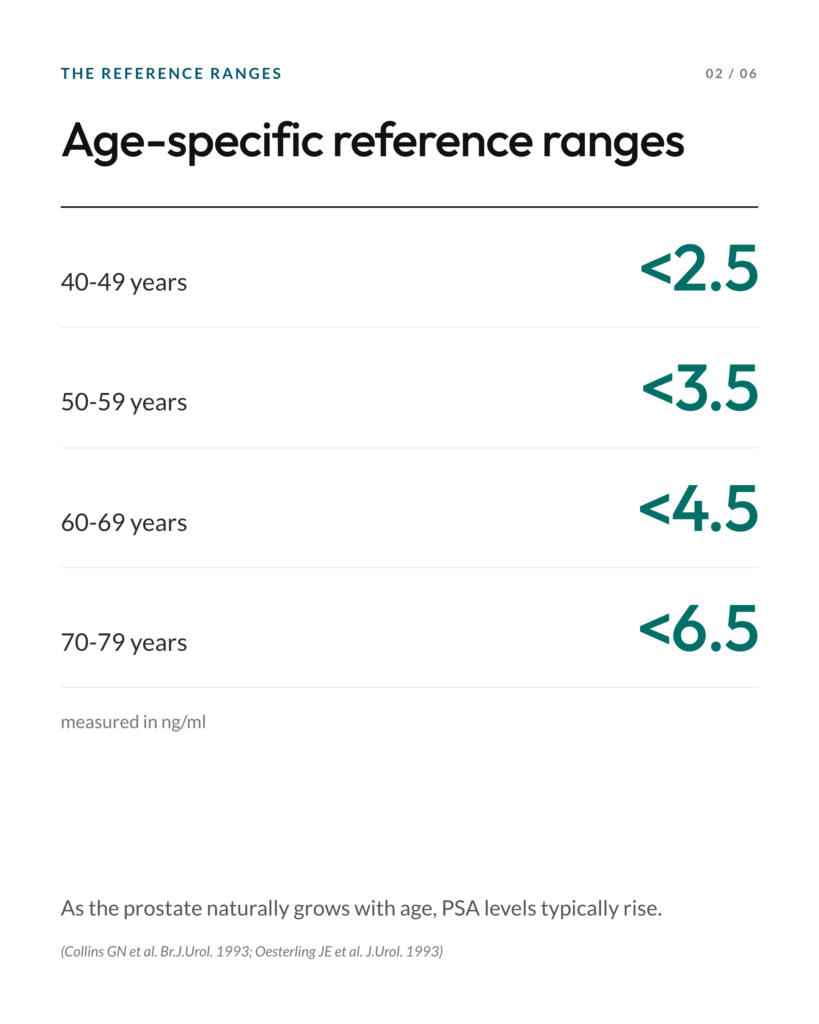
As the prostate naturally grows with age, PSA levels typically rise. Understanding what is “normal” for your specific age group is the first step in moving from uncertainty to a structured, clinical plan.
Relevant Fact: The 0.1 Rule
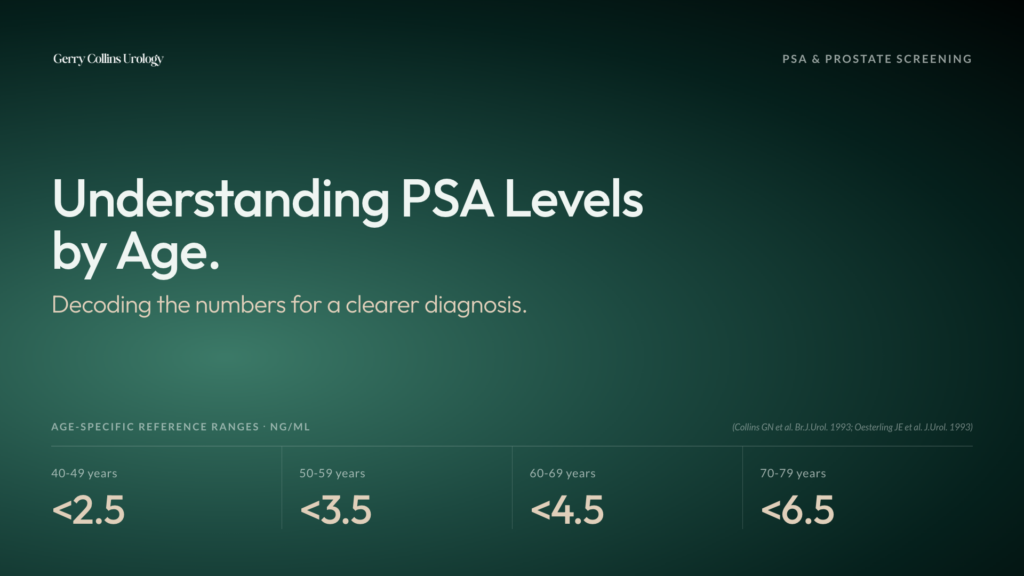
PSA gradually increases with time in the healthy prostate, partly due to volume increase but also independently. Research has shown that healthy prostate tissue produces approximately 0.1 ng/ml of PSA for every cubic centimetre (cc) of volume. Crucially, cancerous tissue produces roughly 10 times more PSA per unit of volume. This means a benign 50cc gland could naturally generate a PSA of around 5.0 ng/ml without cancer being present. This biological reality led to the establishment of age-specific reference ranges:
- 40-49 years: <2.5 ng/ml
- 50-59 years: <3.5 ng/ml
- 60-69 years: <4.5 ng/ml
- 70-79 years: <6.5 ng/ml
(Collins GN et al. Br.J.Urol. 1993; Oesterling JE et al. J.Urol. 1993)
The Red Flags: When to worry
A high PSA result on its own is a “biochemical” red flag, but it is rarely accompanied by physical symptoms in the early stages of cancer. However, you should seek a specialist consultation if a raised PSA is accompanied by:
- A sudden change in urinary habits, such as needing to pee more frequently at night (nocturia).
- A weak or hesitant urinary stream.
- The sensation that the bladder is not completely empty after urinating.
- Blood visible in the urine (haematuria) or semen.
- Unexplained pain in the lower back, hips, or pelvis.
Mr Gerry’s Approach: Why his technique is different
Mr Gerry Collins approaches PSA interpretation as a “biological puzzle” rather than a simple pass/fail test. With nearly three decades of experience and having conducted pivotal MD research on PSA and prostate volume at Edinburgh University and the Mayo Clinic, he avoids “reflex medicine.”
While many clinics might rush to biopsy based on a single number, Mr Collins applies “Clinical Discernment.” He looks at PSA Density (the relationship between PSA level and prostate size) and PSA Velocity (how fast the number is rising over time). By filtering the “noise” created by benign enlargement (BPH) or inflammation (prostatitis), he ensures that only those who truly need invasive investigations proceed to them. His goal is the “One Source of Truth,” providing a measured intervention that balances the necessity of cancer detection with the avoidance of over-treatment.
Causes & Risk Factors
Several factors can cause PSA levels to fluctuate or remain elevated:
- Benign Prostatic Hyperplasia (BPH): As the prostate enlarges with age, it naturally produces more PSA.
- Prostatitis: Infection or inflammation of the gland can cause PSA levels to spike significantly.
- Age: As established, the baseline “normal” shifts as you get older.
- Recent Activity: Vigorous exercise (like cycling) or ejaculation within 48 hours of the test can temporarily raise levels.
- Ethnicity and Genetics: Men of Black African or Caribbean heritage, and those with a family history of prostate or breast cancer, have a statistically higher risk of aggressive disease.
The Solution: Treatment pathways
If a PSA level is outside the age-specific reference range, Mr. Collins follows a structured, risk-stratified diagnostic pathway:
- Advanced Biomarkers: Utilizing tools like the Stockholm3 test, which combines protein biomarkers and genetic markers to provide a much more accurate risk profile than PSA alone.
- MRI-Guided Assessment: High-quality multi-parametric MRI scans help distinguish between suspicious lesions and benign tissue.
- Targeted Biopsy: If imaging suggests a risk, a precision biopsy is performed to sample only the areas of concern.
- Management Strategies: For confirmed low-risk cancer, “Active Surveillance” is often the preferred route. For more aggressive cases, Mr. Collins coordinates surgical or systemic treatments tailored to the individual’s biology.
The Prevention: Lifestyle tips to do at home
While you cannot control age or genetics, you can support prostate health and ensure PSA test accuracy:
- Prepare for the Test: Avoid ejaculation and heavy pelvic exercise (like long-distance cycling) for 48 hours before your blood draw to prevent a false “spike.”
- Dietary Support: Diets rich in lycopene (found in cooked tomatoes) and healthy fats (like Omega-3) are linked to better prostate health.
- Weight Management: Obesity is often linked to lower PSA readings that may “mask” underlying cancer, while also increasing the risk of more aggressive disease.
- Routine Monitoring: If you are over 50, establish a baseline PSA. Tracking the trend over years is far more valuable than a single, isolated snapshot.
FAQs: Common questions
Can my PSA level go down?
Yes. If the elevation was caused by infection or inflammation, PSA levels will often return to baseline after treatment with antibiotics or a period of rest.
Does a PSA of 5.0 always mean cancer?
Not necessarily. As noted in the 0.1 rule, a man with a large 50cc prostate can naturally have a PSA of 5.0. This is why measuring the volume of the gland via ultrasound or MRI is essential to calculate PSA Density.
Is the PSA test 100% accurate?
No test is perfect. PSA is “prostate-specific” but not “cancer-specific.” It tells us there is activity in the prostate, but it requires a specialist like Mr. Collins to determine if that activity is benign growth or something more serious.
What is a “dangerous” PSA level?
There is no single “danger” number. A PSA of 4.0 might be concerning for a 45-year-old but perfectly normal for a 75-year-old. The context of age, volume, and history is everything.