+44 0161 495 7011 (9am - 5pm ᐧ Mon - Fri)

Bone thinning is still widely thought of as a women’s condition. It isn’t. Mild bone thinning (osteopenia) and the more marked form (osteoporosis) are common in men over the age of 50, and around one third of all fragility fractures occur in men.
These are not trivial injuries. A fragility fracture a break caused by a fall from standing height or less— can permanently alter a man’s independence, mobility and confidence. Following a hip fracture in particular, the mortality risk in the first year is in the region of 24%, which is considerably higher than the equivalent figure in women. Despite this, male bone health remains substantially under-investigated and under-treated.
There is also a specific urological dimension to this, which is why bone health sits firmly within my practice. Two of the most common scenarios I see — low testosterone and hormone therapy for prostate cancer — both drive rapid bone loss.
What is osteoporosis, and how does it differ from osteopenia?
Bone is living tissue. It is continually broken down and rebuilt throughout life, and it acts as the body’s main mineral reservoir; the minerals stored in bone include calcium, phosphorus and magnesium.
Peak bone mass is typically reached in the late twenties. From then on, bone is gradually lost. When the rate of breakdown outpaces the rate of rebuilding, bone mineral density falls and the internal architecture of the bone becomes more porous and fragile.
- Osteopenia — bone density is below normal but not yet in the osteoporotic range. Often a warning sign rather than a diagnosis requiring drug treatment.
- Osteoporosis — bone density has fallen far enough that fracture risk is significantly increased.
The distinction is made on a DEXA scan and expressed as a T-score (see below).
(Image: Cleveland Clinic)
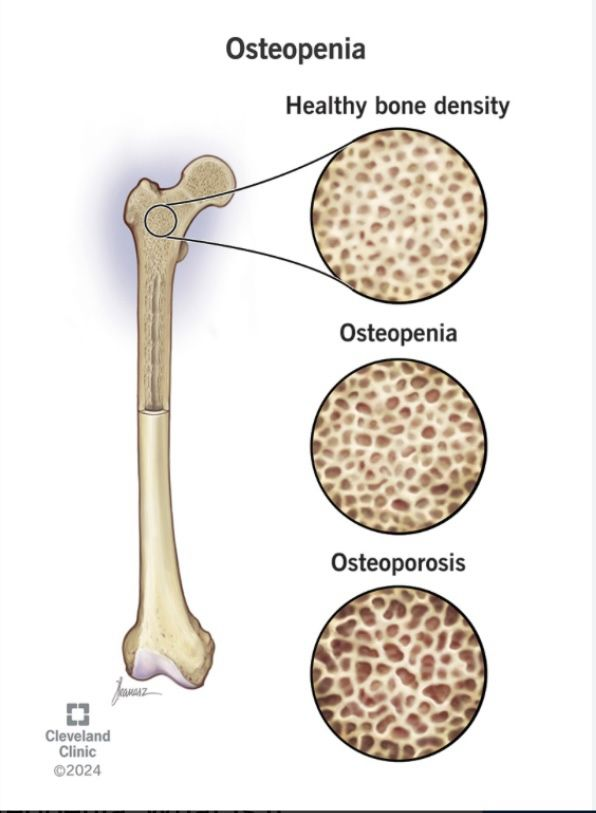
Crucially, osteoporosis causes no symptoms until something breaks. There is no ache, no stiffness, no warning. The first sign is very often the fracture itself, which is precisely why identifying men at risk before that point matters so much.
Risk factors for osteoporosis in men
Nutrition: calcium and vitamin D intake. About 40% of men in the UK have inadequate vitamin D levels. This is related to our climate and sunlight exposure.
Exercise: reduced physical activity carries an increased risk of osteoporosis.
Smoking and high alcohol intake: Both directly impair bone formation. Smoking is also a shared risk factor across urology; it is the single biggest modifiable risk factor for bladder cancer and is strongly associated with kidney cancer as well. If you need one more reason to stop, your skeleton is it.
Coexisting conditions: rheumatoid arthritis, inflammatory bowel disease (Crohns, ulcerative colitis), chronic liver or kidney disease.
Hypogonadism: of particular relevance to us urologists. Low testosterone levels also cause low mood, decreased libido and low energy levels. This is an easily treated condition.
Medications: steroids, hormone treatment and possibly weight loss drugs.
Hormone treatment is a common and very effective treatment used in prostate cancer. It causes significant bone loss, particularly in the first year of treatment.
Patients on or about to start this treatment should be on bone protection therapy (generally in tablet form) and usually calcium and vitamin D supplementation. In my practice, I do baseline calcium, vitamin D levels and ideally a pretreatment DEXA scan, though this can be done after treatment has started.
Sarcopenia (loss of muscle mass/quality) is another side effect, and targeted exercise regimes are very helpful in this regard. High specification DEXA scanners can measure muscle quality in addition to bone quality.
Nocturia, night-time falls and fracture risk — the urological link
This connection is consistently overlooked, and it matters enormously.
Many of the men I see have nocturia — waking repeatedly at night to pass urine. It’s one of the most common lower urinary tract symptoms (LUTS), and is very frequently caused by benign prostatic hyperplasia (BPH) in older men. It’s also a prominent feature of interstitial cystitis and bladder pain syndrome.
Can men get osteoporosis?
Yes. Around one in five men over 50 will sustain a fragility fracture, and roughly a third of all osteoporotic fractures occur in men. Male osteoporosis is significantly under-diagnosed, partly because it is still perceived as a women’s condition.
Can bone density be improved after 70?
Yes, although gains are typically modest, meaningful improvement is achievable at any age through progressive resistance training, adequate calcium, vitamin D and protein, and medication where indicated. Even where density doesn’t rise substantially, slowing further loss and reducing falls delivers a real reduction in fracture risk.
Does a raised PSA mean I have prostate cancer?
No. PSA can be elevated for many benign reasons, including infection, an enlarged prostate and recent instrumentation. Our page on when a raised PSA is not cancer explains this in detail, and free PSA and PSA density cover the refinements used to interpret borderline results more accurately.
What is peak bone mass?
Peak bone mass is the maximum bone density you achieve in your lifetime, typically reached in the late twenties. The higher your peak, the more reserve you have as bone is gradually lost with age.
Is swimming good for bone density?
Swimming is excellent for cardiovascular health, joint comfort and muscle conditioning, but because the water supports your body weight, it provides very little bone-building stimulus. Swimmers should add land-based weight-bearing exercise.